
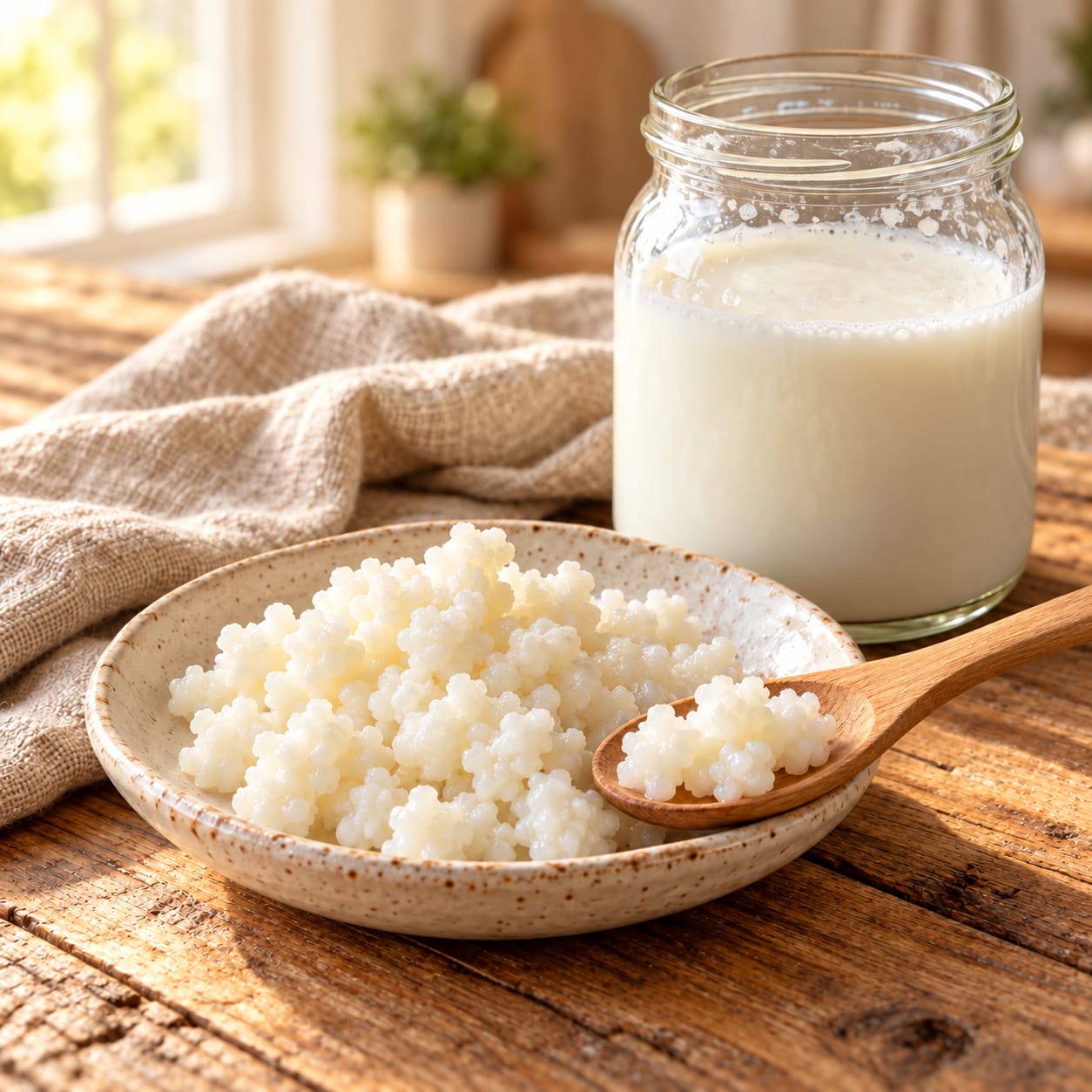
Small Grains. A Remarkable Transformation.
Often called the “Tibetan milk mushroom”, kefir grains are a living community of bacteria and yeasts. These small, creamy-white clusters, resembling tiny cauliflower florets, are used to ferment milk.
Once the grains are added to milk, fermentation begins. Gradually, the milk’s flavour, aroma and texture change, and some of its natural sugar, lactose, is broken down. The result is a distinctive drink: refreshing, pleasantly tangy, gently creamy and sometimes lightly effervescent.
Milk, a living culture and time — simple ingredients for a drink with a character of its own.
Why Discover Tibetan Milk Kefir?
Kefir brings together the nutritional value of milk and the distinctive qualities of traditional fermentation. It is an appealing choice for anyone looking to add variety to their diet, enjoy more fermented foods and discover a fresh, naturally tangy flavour.
Protein for Everyday Nourishment
Milk kefir contributes protein to your diet, helping your body maintain and repair its tissues. It is easy to enjoy with breakfast or as a nourishing snack between meals.
Calcium for Bones and Teeth
Dairy foods are an important source of calcium. Kefir offers another enjoyable way to include this mineral in your diet, helping to maintain normal bones and teeth.
Live Cultures at the Heart of Traditional Kefir
Kefir that has not been heat-treated after fermentation retains live microorganisms. Its community of bacteria and yeasts is one of the drink’s defining characteristics, attracting the interest of fermented-food enthusiasts and researchers alike.
An Alternative to Milk That Some People Tolerate Better
Fermentation breaks down some of the lactose in milk. In a small study involving adults who had difficulty digesting lactose, kefir was better tolerated than milk. Individual tolerance varies, but this is one reason people choose to explore fermented dairy foods.
A Flavour Worth Taking a Moment For
A refreshing first sip, a pleasant tang and a gentle milky flavour — kefir has a character that rewards discovery. Its aroma and thickness vary with the milk you choose and the fermentation conditions. These subtle differences are part of traditional fermentation.
Some people enjoy kefir just as it is. Others discover their favourite combination with berries, fruit or fresh herbs. A handful of ripe strawberries adds a touch of summer sweetness, banana brings a mellow creaminess, while cucumber and dill reveal its fresh, savoury side.
Enjoy it simply, or make it your own.
A Living Tradition in Your Kitchen
One of the most appealing qualities of kefir grains is that they can be used again and again. Once the finished kefir has been strained, properly cared-for grains can be added to fresh milk to begin the next fermentation. The same culture can produce many fresh batches.
Making kefir becomes a small household ritual: choosing your milk, tending your culture and enjoying a drink you have prepared yourself. There is pleasure in knowing what goes into it, discovering favourite combinations and sharing the results with those around you.
One living culture. Many fresh batches. A tradition you can continue at home.
How to Enjoy Kefir Every Day
Kefir fits easily into everyday meals, from a quick breakfast to a relaxed evening at home.
- For breakfast: pour over oats and add berries and chopped nuts.
- For a refreshing smoothie: blend with banana, strawberries, raspberries or blueberries.
- For a simple snack: enjoy a small glass on its own.
- At lunchtime: use as a base for Lithuanian chilled beetroot soup or a refreshing cucumber soup.
- For a dressing: mix with dill, garlic and your favourite seasonings.
Start with a small serving and find an amount that suits you. Kefir might become part of your breakfast or a favourite afternoon snack. What matters most is that you enjoy it and tolerate it well.
Simple Care. A Rewarding Routine.
When making kefir, use pasteurised milk and clean, food-safe utensils and containers. Follow your culture supplier’s instructions for fermentation and care. Keep the finished drink refrigerated and follow the storage guidance provided.
Caring for your culture becomes a natural part of the process — along with looking forward to the next freshly prepared batch.
Discover Your Own Kefir Ritual
Your first glass, your first favourite combination, your first homemade batch — discovering kefir begins with small pleasures.
Bring this time-honoured tradition to your table. Taste it on its own, pair it with ingredients you love and discover how easily it can become part of your everyday life.
Tibetan Milk Kefir — a culture treasured through generations, ready to become part of your home.
Kefir made with milk contains MILK proteins and may contain residual lactose.
TIBETAN MILK KEFIR GRAIN CARE GUIDE
Simple instructions for making kefir, caring for your growing grains and storing them during a break.
1. Prepare Your Equipment
You will need a clean glass jar, a fine-mesh sieve and a spoon. A food-safe plastic or stainless steel sieve is suitable.
Wash your hands before starting. Wash and rinse all equipment thoroughly.
2. Start with a Smaller Amount of Milk
When your grains arrive, add approximately 1 tablespoon of grains to 250–300 ml of pasteurised milk. The grains may need time to recover after their journey.
Choose full-fat cow’s milk, labelled “Whole Milk” in UK shops. The milk should be at room temperature, approximately 20–25°C, rather than hot. There is no need to add sugar.
Once the grains reliably ferment the milk in around 24 hours for several consecutive batches, gradually increase the milk to 400–500 ml.
3. Cover and Leave to Ferment
Cover the jar with a paper coffee filter secured with an elastic band, or use a loosely fitted lid.
Do not seal the jar tightly during fermentation.
Keep it at room temperature, away from direct sunlight and radiators. Active grains usually ferment milk within 18–24 hours.
4. Check How the Milk Is Fermenting
The milk will usually thicken and develop a characteristic tangy, fermented-milk aroma. A little pale yellow liquid may separate — this is whey. The thickness of the finished kefir can vary.
If there are no clear signs of fermentation after 24 hours, do not drink that batch. Strain out the grains, discard the milk and add fresh milk. Do not leave the same batch sitting warm for several days.
After transport or storage, use the first batches to reactivate the grains. Only start drinking the kefir once the culture consistently ferments milk as expected in around 24 hours over several consecutive batches.
Appearance and smell alone cannot guarantee safety, so follow the full preparation and storage instructions.
5. Strain the Kefir
Place the sieve over a clean bowl and pour in the contents of the jar. Stir gently to help the kefir drain through. Do not force the grains through the mesh.
The liquid in the bowl is your kefir. The grains left in the sieve are used for the next batch.
6. Refrigerate the Finished Kefir
Once your grains are working reliably, you can drink the strained kefir straight away.
Pour any remaining kefir into a clean container with a lid and refrigerate immediately at 4°C or below.
For a simple home routine, make small batches and use within 3 days, provided the kefir has been prepared correctly and kept refrigerated throughout.
7. Add Fresh Milk to the Grains
Transfer the strained grains to a clean jar and add fresh milk.
There is no need to rinse the grains with water after each batch.
A little kefir remaining on the grains is normal.
Add fruit, honey or other flavourings only to the finished drink, after removing the grains.
8. Your Grains Grow — Separate Any Excess
Kefir grains are a living, growing culture. With suitable care, their quantity increases. More grains will ferment the same amount of milk more quickly.
Approximately once a week, check how many grains you have after straining. If the amount has increased, set some aside and keep your usual quantity for the next batch.
For example: if you started with one tablespoon of grains and now have two, keep one tablespoon for making kefir and set the other aside.
You can give the extra grains to someone else or freeze them as a backup. There is no need to crush or chop them — simply separate a portion with a clean spoon.
If your kefir starts fermenting much faster than usual, remove the excess grains sooner rather than waiting until the end of the week. Growth rates vary, so keep an eye on your own culture.
9. Refrigerate the Grains for a Short Break
Place the grains in a clean jar, cover generously with fresh milk, fit a lid and refrigerate.
This is a convenient option for a 1–2 week break. If possible, replace the milk after approximately one week.
When you are ready to start again, strain off and discard the storage milk. Add fresh milk and reactivate the grains as described in Steps 13–14.
Freezing and Reactivating Your Kefir Grains
10. Freeze the Grains in Milk for a Longer Break
Only freeze healthy grains that are actively fermenting milk.
After straining, place them in a small, clean, freezer-safe plastic container.
There is no need to rinse or pat the grains dry for this method.
Add fresh pasteurised milk straight from the fridge — just enough to cover the grains completely.
11. Seal, Date and Freeze
Leave approximately one-quarter of the container empty, as milk expands when frozen.
Close the lid securely, label with the date and place straight into a freezer at –18°C or below. There is no need to ferment the milk before freezing.
Freezing several small portions makes it easier to thaw only what you need.
A practical storage period is up to 3 months.
Some culture suppliers suggest storage for up to 6 months, but grains stored for longer may be harder to reactivate.
12. Thaw Slowly in the Fridge
Move the closed container from the freezer to the fridge. Leave until the milk has completely thawed — a small portion will usually take around 24 hours.
Do not thaw in a microwave, in hot water or on a radiator.
13. Add Fresh Milk to the Thawed Grains
Strain the thawed contents and discard the storage milk. Transfer the grains to a clean jar.
For approximately 1 tablespoon of grains, add 250–300 ml of fresh milk at room temperature. Cover loosely and keep at approximately 20–25°C.
Strain and replace the milk with fresh milk every 24 hours.
14. Allow the Grains to Recover
Do not drink the first reactivation batches. Wait until the grains ferment milk as expected in around 24 hours for several consecutive batches.
You can then gradually increase the amount of milk and return to your usual routine.
Recovery may take several days or longer. Not all frozen grains recover. The same reactivation process can also be used after transport or a break in the fridge.
15. Discard the Culture if You Notice Spoilage
If you see fuzzy mould, unusual coloured patches or notice a rotten smell, discard both the milk and the grains.
Do not try to rescue a spoiled culture by rinsing it.
Reviews
There are no reviews yet.